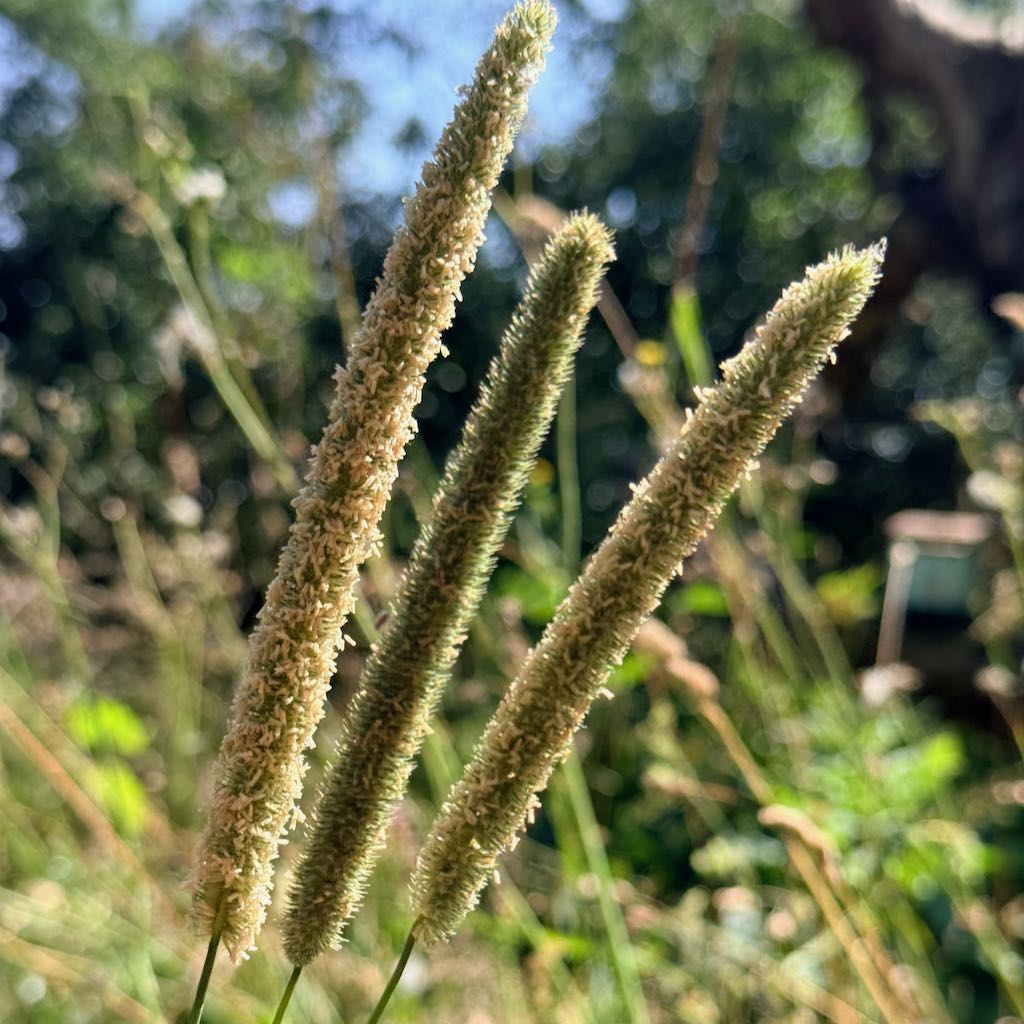
This hairless perennial grass forms dense, smooth clumps featuring flat, sharply pointed, grey-green leaf blades. Its stems are uniquely characterized by hard, bulbous, onion-like swellings at the very base. In summer, it produces stiffly upright, tightly packed, cylinder-shaped flower spikes. These sleek, unbranched flower spikes look remarkably like fuzzy, green-to-purple cat tails swaying in the wind.
Interesting Facts
Originally native to Europe, its famous common name honors Timothy Hanson, an American agriculturalist who famously promoted its seeds in the 1720s, transforming it into a vital global forage crop. It features a unique, swollen stem base that acts as a survival food storage organ. Today, it is highly prized worldwide as the gold standard for premium hay.
Importance to Wildlife
An absolute cornerstone for open meadow biodiversity, it functions as a primary larval host plant for diverse native butterfly species, including the Essex Skipper, Small Skipper, and Marbled White. Its tall, sturdy stems provide vital summer nesting architecture and shelter for small field mammals. Come autumn, its massive, dense seed heads yield a crucial food supply for foraging songbirds.
Advice
Timothy Grass is non-toxic for all animals.