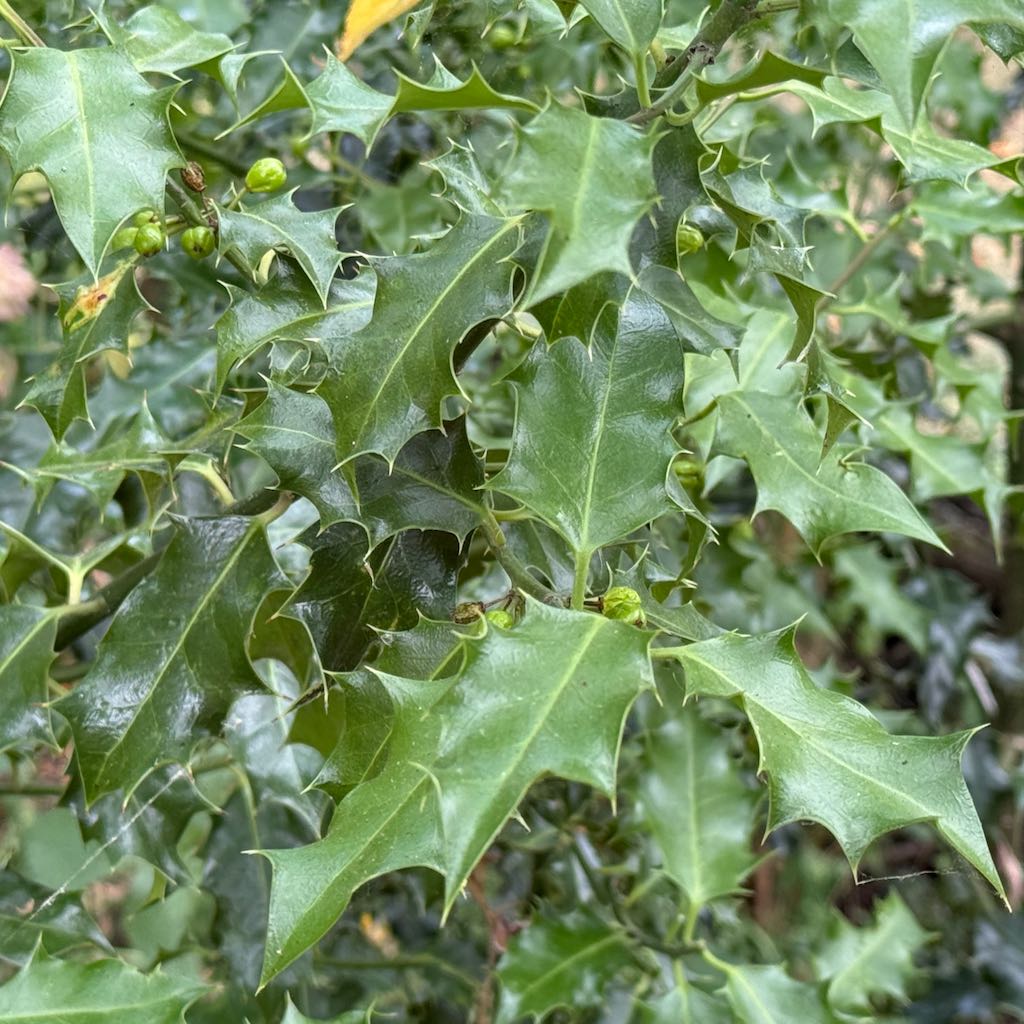
Holly is a striking, densely branched evergreen tree famous for its architectural, glossy dark-green leaves, which feature wavy margins and sharp, rigid spines. The smooth, silver-grey bark often becomes beautifully textured with age. In spring, it produces subtle clusters of small, four-petalled white flowers. On female trees, these transition into spectacular, globose, bright crimson berries that persist vividly throughout the winter.
Interesting Facts
Steeped in ancient winter folklore, holly was brought indoors during Saturnalia and Yule celebrations to ward off evil spirits and offer shelter to woodland fairies. Culturally, it forms half of the ultimate festive botanical duo alongside mistletoe. Intriguingly, holly displays heterophylly; the tree only grows prickly leaves on its lower branches to deter browsing deer, while its upper canopy leaves are completely smooth.
Importance to Wildlife
Holly is an absolute oasis for winter biodiversity. Its dense, prickly evergreen canopy provides superb, predator-proof roosting and nesting shelter for birds like thrushes and woodpigeons. The late-spring flowers are an essential nectar source for bees and hoverflies, and the leaves nourish caterpillars of the holly blue butterfly. Come winter, the vitamin-rich red berries supply a critical survival feast for thrushes, fieldfares, and small mammals.
Advice
Holly is toxic to humans, dogs, cats, and horses.