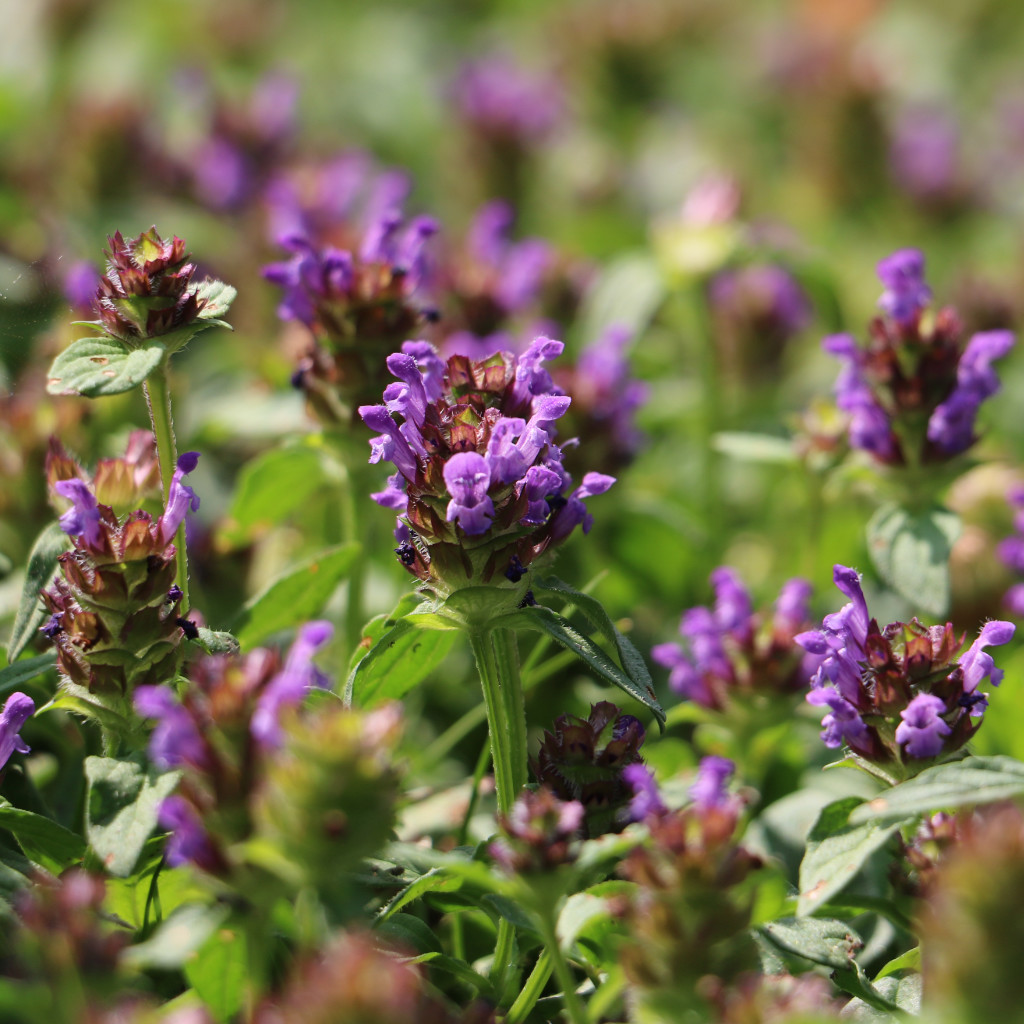
Self-heal is a creeping, mat-forming member of the mint family featuring distinctively square, slightly hairy stems. Its oval, dark green leaves sit in opposite pairs, often tinted purple along the margins. The plant is crowned by dense, terminal, club-like spikes of tightly packed, hooded, two-lipped flowers. These nectar-rich blossoms display a vibrant violet-blue or deep purple colour, beautifully contrasted by reddish-purple brackets underneath.
Interesting Facts
Living up to its common names, this plant was a legendary “cure-all” in traditional global herbalism, used by Native Americans, Chinese practitioners, and European healers alike. Modern medical researchers are actively studying self-heal for its potent antiviral, antibacterial, and antioxidant properties, particularly its efficacy against herpes simplex and its ability to help regulate blood sugar levels. Historically, wood-carvers and carpenters kept it nearby to immediately staunch bleeding from workshop injuries.
Importance to Wildlife
This long-blooming wildflower is an outstanding, reliable service station for local pollinators, particularly in late summer. Its deeply tubular, hooded flowers are evolutionary favorites for long-tongued insects, heavily attracting bumblebees, honeybees, carder bees, and hoverflies. Because it creeps low and forms dense, interwoven carpets, the foliage provides excellent micro-habitats and cool, damp shelter for beneficial garden beetles, spiders, and other invertebrates.
Advice
Self-heal is completely non-toxic to humans, dogs, cats, and livestock. It contains no poisonous chemical compounds, making it entirely safe to touch and manage without gloves. In fact, the entire plant is fully edible and highly nutritious. The young leaves and stems can be eaten raw in salads, cooked as a pot herb like spinach, or dried and brewed into a pleasant, health-boosting herbal tea.