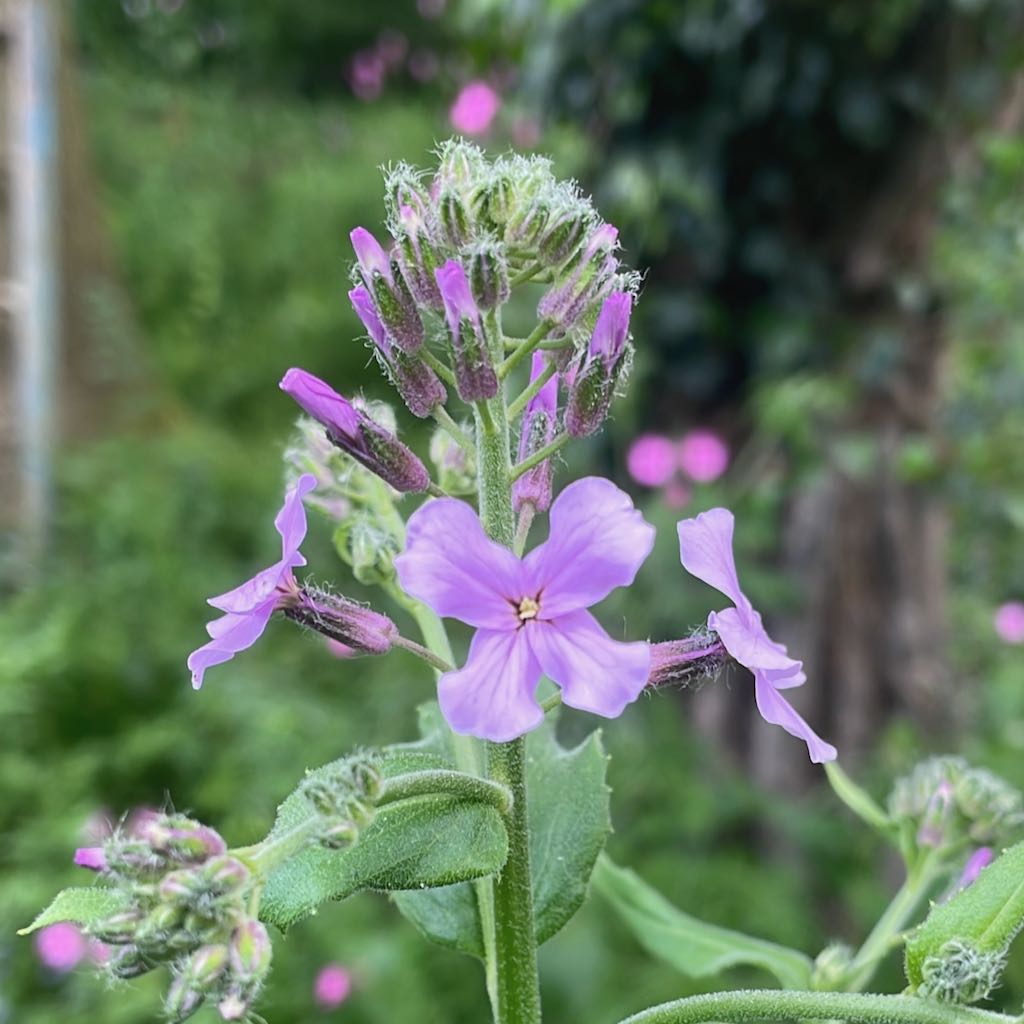
This upright, branching plant features sturdy, hairy stems lined with dark green, lance-shaped leaves with finely toothed edges. It produces loose, terminal clusters of elegant, four-petalled flowers. The fragrant blossoms range from deep violet and lilac to pure white, visually resembling phlox but easily distinguished by having four petals instead of five.
Interesting Facts
Its Latin genus name Hesperis translates to “evening,” celebrating the plant’s unique habit of releasing a rich, sweet, violet-like perfume only as twilight approaches. Introduced to Britain in the 14th century, it became a beloved fixture of traditional cottage gardens. Despite its common name, it belongs to the mustard family (Brassicaceae), not the true violet family.
Importance to Wildlife
An exceptional asset for evening biodiversity, its dusk-released scent turns the orchard into a magnet for nocturnal pollinators, specifically targeting hawkmoths and night-flying beetles. By day, the remaining open blooms provide a rich source of nectar and pollen for bumblebees, hoverflies, and butterflies. It also serves as a vital larval host plant for the beautiful Orange-tip butterfly.
Advice
Dame’s Violet only appears occasionally so you’ll need to be lucky to see it.