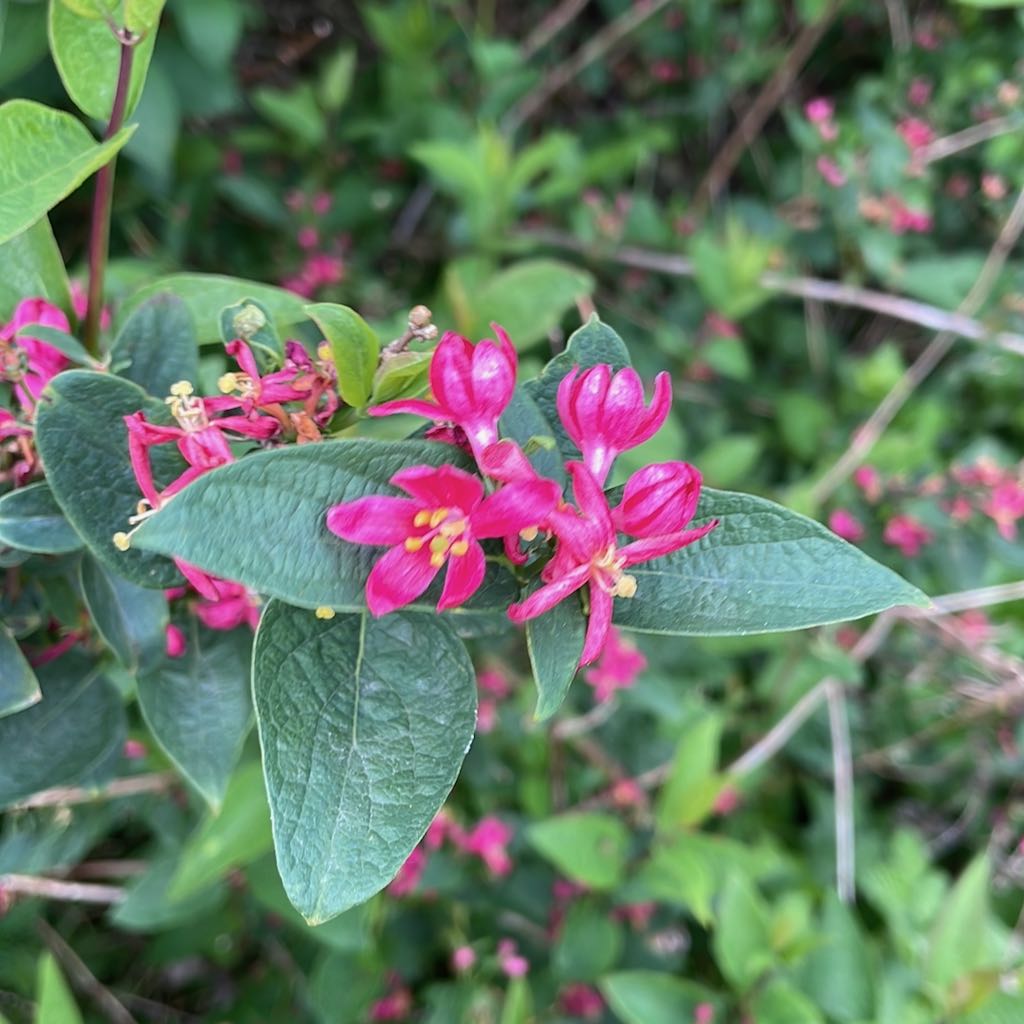
This upright, deciduous perennial shrub forms a dense, bushy mound with arching branches and egg-shaped, bluish-green leaves. In late spring, it produces pairs of tubular, two-lipped flowers that range from deep pink to white, featuring noticeably protruding yellow stamens. These abundant blossoms transition by late summer into smooth, shiny, globe-shaped bright red or orange berries.
Interesting Facts
Native to Siberia and East Asia, this incredibly rugged shrub is heavily used globally for windbreaks due to its extreme cold tolerance. However, its success has a dark side. Introduced to other regions as an ornamental, it escaped cultivation and became aggressively invasive. It secretes allelopathic chemicals into the surrounding soil, actively poisoning and suppressing native plants. In short, it shouldn’t really be in the orchard and needs to be carefully watched in case it gets too big. The only specimen is at the corner of the back hedgerow.
Importance to Wildlife
In its introduced environments, it offers a complicated ecological balance. The fragrant, nectar-rich spring flowers provide a valuable food source for migrating bees, and butterflies. In late summer, its abundant red berries are heavily consumed by various songbirds. Unfortunately, these berries are low in essential fats, offering poor-quality nutrition compared to native autumn fruits.
Advice
Don’t go near the plant, it contains some unpleasant toxins.