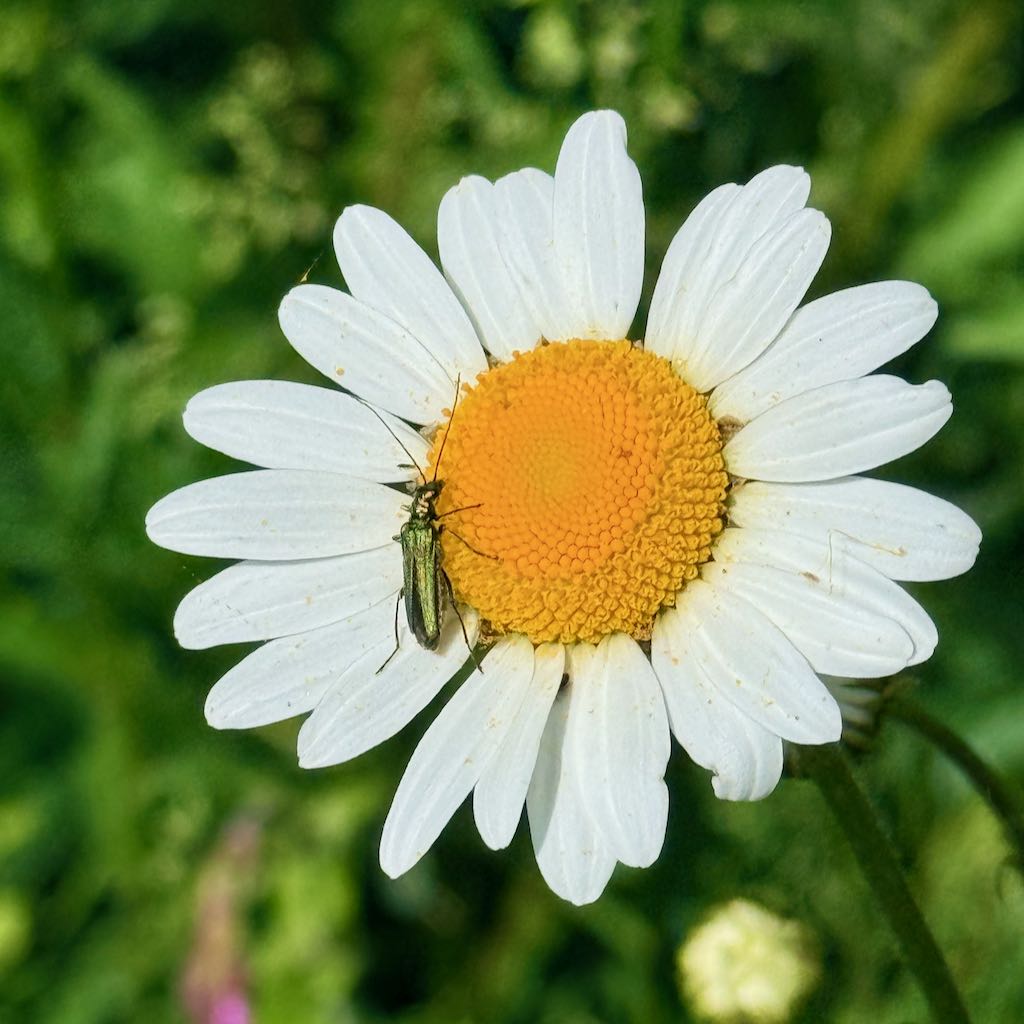
The oxeye daisy is a tall, elegant grassland perennial that stands as Britain’s largest native daisy species. It develops a winter-green rosette of dark green, toothed, spoon-shaped basal leaves. From this base, wiry, mostly unbranched stems rise to support large, solitary flower heads measuring up to 6 cm across, featuring crisp white ray petals encircling a flat, vibrant yellow central disc.
Interesting Facts
The genus name Leucanthemum comes from the ancient Greek words meaning “white flower”. Its popular folk name “moon daisy” reflects how the large, luminous white blossoms vividly appear to glow in twilight and evening moonlight. Once highly widespread, the plant divides modern opinion; while beloved by gardeners, its aggressive, “bomb-proof” growth allows it to dominate meadows and crowd out less vigorous flora if soil nitrogen levels become too high.
Importance to Wildlife
This species is an invaluable ecological asset, prominently featured on the RHS Plants for Pollinators list. Its broad, flat, open flower platforms act as a massive “nectar cafe,” offering easy landing zones and feeding opportunities for bees, hoverflies, butterflies, and beetles. Intriguingly, the patchwork leafcutter bee actively harvests its white petals to line underground nests, while the dense foliage provides ground-level shelter for predatory beetles.
Advice
While the leaves and opened flower heads are edible for humans, oxeye daisy is toxic to dogs, cats, and horses.