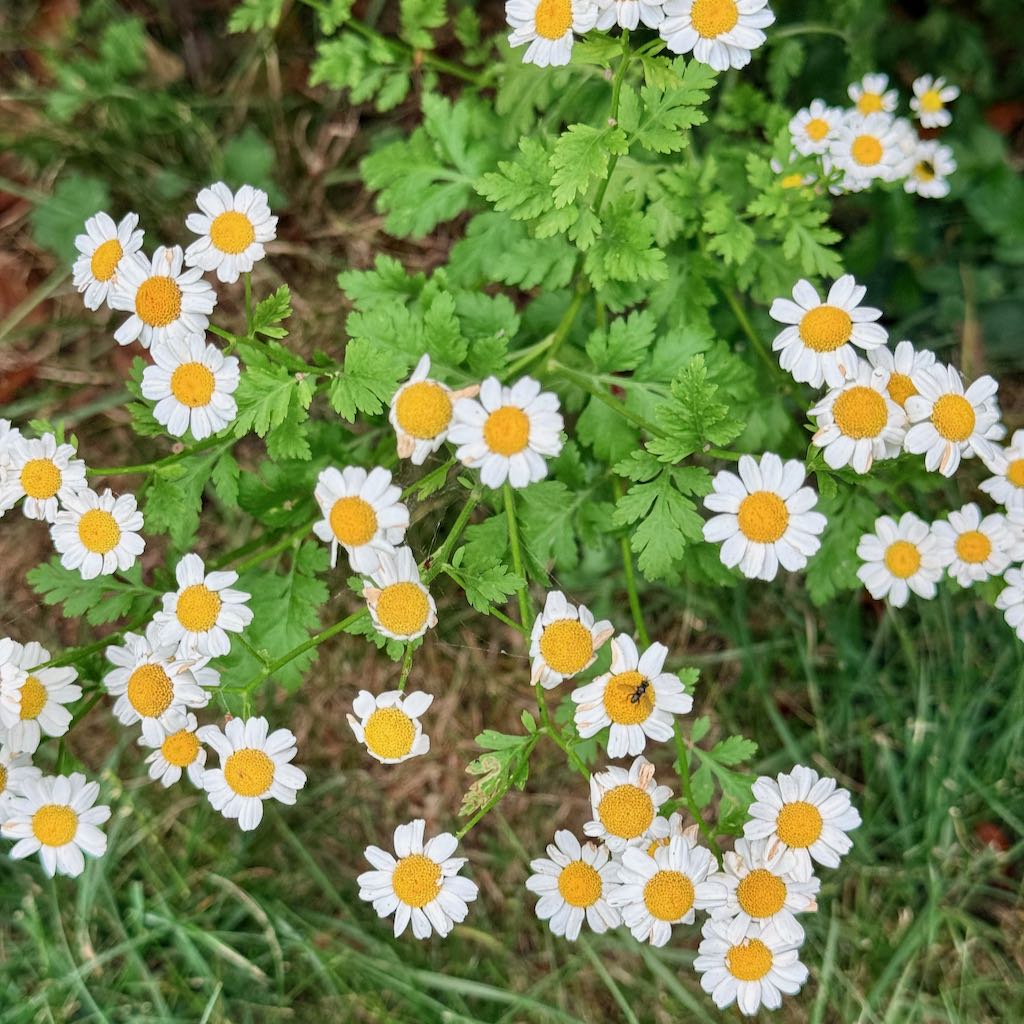
This aromatic perennial grows in bushy clumps, featuring deeply cut, yellowish-green leaves that emit a strong, citrus-bitter scent when crushed. It produces a dense abundance of small, daisy-like flower heads. Each blossom consists of a bright yellow central disc surrounded by a single ring of short, flat, pure white petals, creating a cheerful, classic cottage-garden appearance.
Interesting Facts
Its common name derives from the Latin febrifugia, literally meaning “fever driver,” reflecting its ancient use as an aspirin-like remedy. Historically planted around houses to purify the air and ward off malaria, modern clinical science validates its traditional reputation; its active compound, parthenolide, is widely used today in specialised herbal supplements to prevent severe migraine headaches.
Importance to Wildlife
The bright, open daisy flowers offer an easily accessible, late-summer nectar platform for a wide range of beneficial predatory insects, including hoverflies, ladybirds, and lacewings. By attracting these insects, it acts as a natural pest-control agent for orchard trees. The dense foliage provides excellent shelter for ground beetles, while small garden birds feast on its autumn seeds.
Advice
Feverfew is difficult to find in the orchard; you’ll have to look really hard to find it.