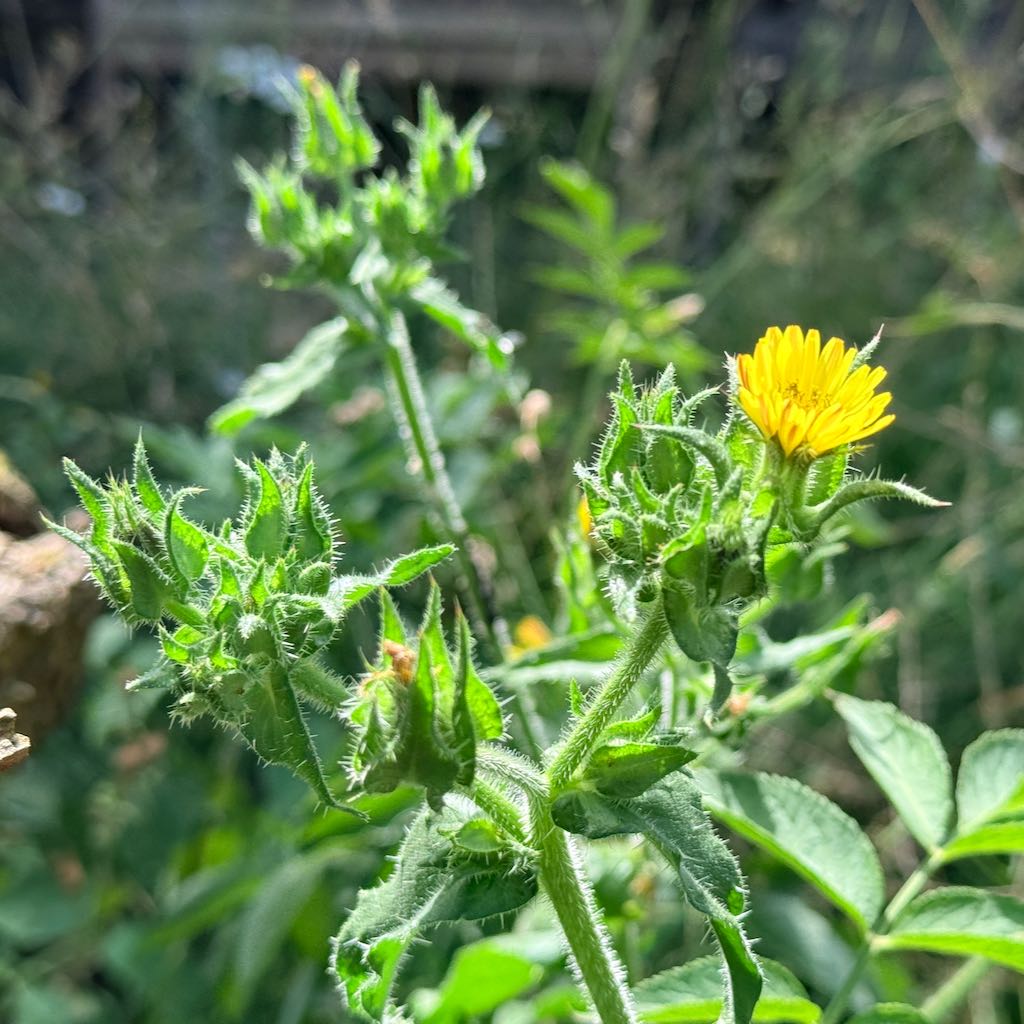
Bristly oxtongue is a robust, well-branched wildflower easily recognized by its distinctive, intensely rough texture. Its oblong, wavy-edged leaves are uniquely covered in white, blister-like pimples, each bearing a sharp, hooked bristle that mimics the rough surface of a bovine tongue. It produces clusters of pale-yellow, dandelion-like flowers measuring up to 25mm across, nested above distinctive heart-shaped outer bracts.
Interesting Facts
Originating in the Mediterranean, this resilient pioneer species has successfully naturalised worldwide. Its unusual genus name, Helminthotheca, references traditional herbalism, where it was utilised as an anthelmintic to expel parasitic intestinal worms. Intriguingly, the plant produces two distinct seed types on a single head: inner seeds feature long “parachutes” for wide wind dispersal, while outer seeds are heavier, landing close to the parent plant.
Importance to Wildlife
Despite its aggressive appearance, this plant is an invaluable resource for local ecosystems, particularly in late summer. Its long-lasting yellow flowers provide a steady supply of energy-rich nectar and pollen for bees, hoverflies, butterflies, and moths. Additionally, the robust foliage serves as vital cover and a direct food source for various invertebrates, while its abundant seed heads feed foraging birds.
Advice
Bristly Oxtongue is non-toxic to humans and animals. In fact, in the past the basal rosette leaves used to be cooked (although the bristles on the leaves may have may it quite unpalatable).