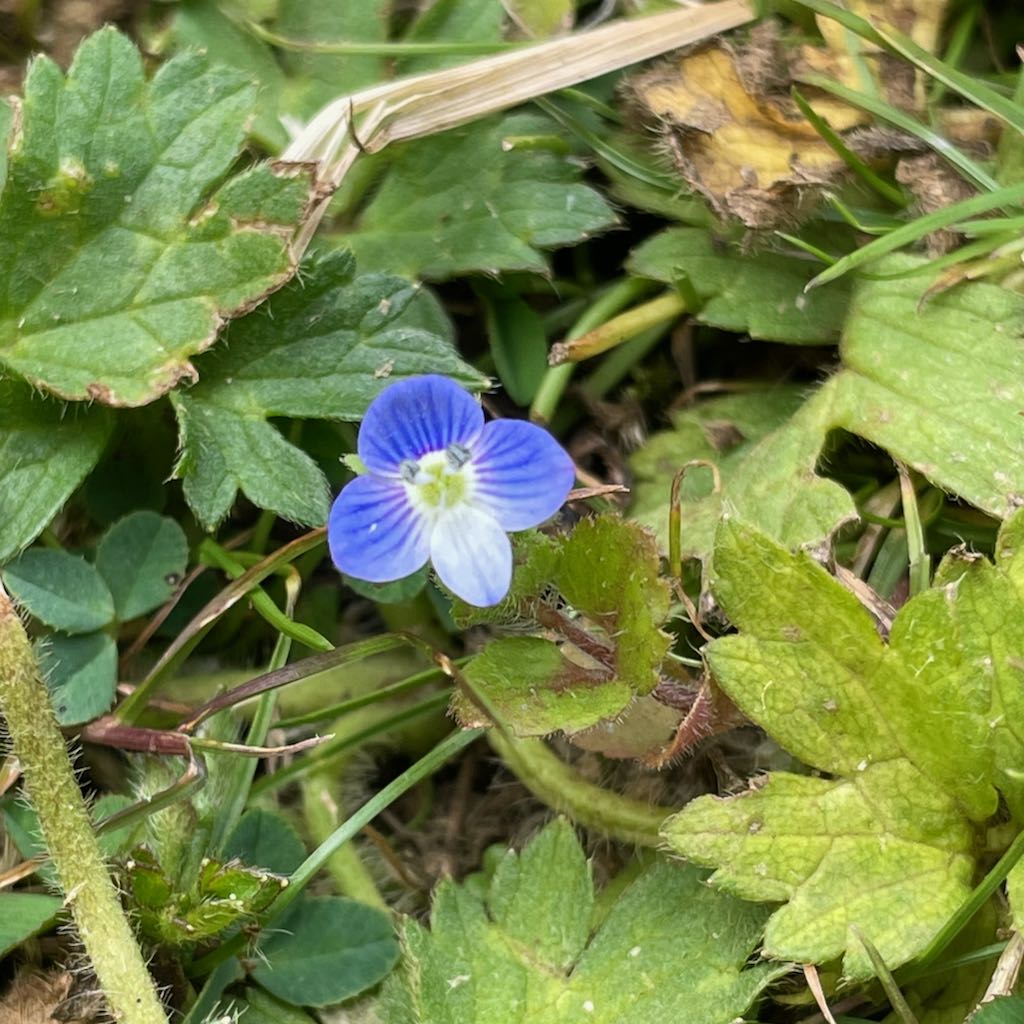
This low, creeping annual features branching, limp stems covered in sparse hairs. Its small, short-stalked leaves are oval, sharply toothed, and display a distinctly dull, grey-green hue compared to its brighter green cousins. It bears tiny, solitary blue flowers with three rich-blue upper petals, a paler bottom petal, and a clean white throat.
Interesting Facts
While native to Southeastern Europe and Asia, it has successfully hitchhiked worldwide to become a global weed of cultivation. Its species name polita beautifully translates to “polished” or “smoothed,” a nod to its shiny leaf surfaces. Historically, it shares the genus legend of Saint Veronica, and it has long been used in traditional folk medicine to dress physical wounds.
Importance to Wildlife
This tiny wildflower serves as a critical, early-season ecosystem asset. Blooming when other plants are dormant, its nectar-rich blue cups provide life-saving, accessible food for emerging solitary mining bees, hoverflies, and small spring beetles. It forms dense, carpeted mats that offer humid shelter for ground insects, while small birds frequently forage for its tiny autumn seeds.
Advice
Grey Field Speedwell is non-toxic to humans and animals.